lunes, 3 de noviembre de 2014

tradition! tradition! tradition!

  
"A fiddler on a roof, it seems crazy, is not it, but in this small village called Anatevka we can say that each of us is like a fiddler on a roof. That is starting his instrument a nice tune as you can without breaking the head. And this is not easy, not created and you probably wonder Why not hold here is that dangerous? The answer I can give at once, we stay here because Anatevka is our home.And how to maintain the balance, that I can answer it in one word: tradition"
Fiddler on the Roof.

Traditions  in culture is one of the most important ideas  for   the society which  has  endured until today. Nowadays,  we can notice that  some  of these ideas have changed thought the years and  it adapts to the  society which changes  thought time  and in this case, Achebe looks forward to show this  breakup between the traditions  of a society  just like  the conquest  is  presented in this country.  Chinua Achebe, shows in  his book things fall apart the  role of the oral traditions and  literature in  the  group where Okonkwo comes from. In this case, the plot starts when Okonkwo  leaves  his village  for 3 years. During those 3 years,  many changes occur to Umofia,  because the  Europeans conquered it.

The main part where they show the traditions that Umofia had   is the first part, where Achebe explains the  cause of  his exile, and the  things that  he used  to do  while  he was in Umofia. An important  part of it would be the Agbala, where the   author explains  that this oracle  was an important  part  of the community when  an old  man was sick or almost dying, because  it would  solve the problems that the old man used to  solve. Another important exaple would  be  the   importance of  music  when an old man died, because they represented an important part of teh community and their death must be known  in all the  villages around this  one.  

Another  example thata Achebe uses along   the first part is when  he  writes about  the stories that his mom  used to tell him, or about the  stories that he used to hear  in his community, because they were like  fables   to  the   kids,  because they taught them an important part of  their culture.  An example of this  would  be the  story about the big turtle that  is told to Okonkwo by his mother,  where she explains him the importante of the old men and  the importance of knowledge. Another important fact would be  the  songs that   the author  includes in some parts of the  story, because each of them  means something to  the  village. 

On the other hand, when Okonwko comes back,  he notices that eveything has changed in Umofia,  and  in this case,   he cannot  go back in time and  live where he wants to live. He needs to get used to the  new traditionst  that they have  un his village, because     everything that the umofians have lived, like   fights, deaths,  new buildings, the destroy of their  traditions,etc. An example of this transition would be the reaction of any of the villages around Umofia,  who also lived this change, with  submission or  fought against the system. 

In conclusion, I think that Conrad tried to explain  the  process in which  a   culture changes  through time, and in thsi case,   he showed the  break up between the umonian  traditions represented  by Okonwko, and the  kew tradtions represented  by  the English man which ends  in a metaphor when  Okonkwo died,  meaning the end  of his  culture. 

martes, 30 de septiembre de 2014

Conrad and Achebe...


"Our true nationality  is  mankind" H. G. Wells

 As  a society, we have got similar ideas, point of views,  traditions and customs; they vary from  country to country,  and they  show  how  people used to behave and think about. The importance of literature is  this simply  idea: to show how the society  has behaved  and  thought of other  societies  and  the way the saw themselves.

 In the case of  Heart of Darkness  by Joseph Conrad,  shows a perspective about  the Africans by   the Europeans; where the use  of the words like "negro", "white",  "irrational", "savages", and "beast"; also, Conrand did not give them  a voice. In  this case,  we can  notice how Conrad expresses this  idea of superiority   with this simple actions that develop the theme;  the racism  that  a society develops  to show  a perspective  about the Africans that was  accepted  by the society and nobody  said  anything against it. 

On the other hand, Achebe   writes about   the society, how  do the african tribes really are,  explaining  their actions rather than demonstrating  their superiority. In this case, his  way of showing it,  is  to  explicate the traditions and  behavior; he, first, examplifies the  tradition or  behavior,  and then he  explains it. An important fact of this,  is that even thought that some of these are considered archaic and show the  instincs,  Achebe shows  the human nature  that  they have.

If we compare both stories,  the  main  difference would be the way to see  the  Africans; but  this idea cannot  be really compared because  the  historical context that  Conrad and Achebe lived are  a centrury  apart  from eachother  and the  way  people saw  their country and  the other countries. Therefore, we can conclude that  this  is the  importance of  african literature: to show how a country developed by the influence of others, and that this country would  not be the same without it. 

In conclusion   the  influence of other countries, shows the globalization that  each country develops  through the years and  the relationships  between  them. The importance of literature  is shown  by how how did the society saw  these relationships and  how did their country or tribe changed  because of this.
 

lunes, 8 de septiembre de 2014

Black or white

"But words are things, and a small drop of ink,  Falling like dew, upon a thought, produces  That which makes thousands, perhaps millions, think."
- George Gordon Byron


As we read in "Heart of Darkness", the use of words like "neger", "others", "white", "slave" and  so on,  denotes the  racism  felt by Conrad and  showed in his character Marlow about the Africans and Europeans. The use of these  might  make  you think that  this author is  racist, or maybe   the  context which he lived taught him that. In my point of view, he uses them  to  make   a comparison  between both cultures, and   he uses, aldo, metaphores to express it  in different ways.

As  a first thought about  this book, is that the writer is  a racist  guy who hated the africans. In this case, this idea is correct, but it is clearly influenced  by the  social context  in which Conrad  lived, because  around  1800,  in Europe, the  need to conquer a place was kept as a main thought, and the  people they  meet in these places,  were "savages". In other words, they were considered  an inferior  race; this idea was  influenced by the other believes  that europeans had. In this case,  along the story, we can notice that   the  main  character, Marlow,  was rude to  them and also was egocentric; but as the story goes on,  he starts  to change a  bit his way of seeing the  africans. Conrad   used  these  words to  express a way of thinking  in the 1800, but also, he tried to  show, how this  thoughts start to change  in  people who  kept in touch with them.

On the other hand,   he uses  light  and  dark as a metaphore of neger and white, which  changes though out   Marlow's point of view. In this case,   we can  notice  it, because Conrad uses  "light" and "dark"  a lot  in his  sentences  and these are located  when Marlow, start to change  his  point of view about them. For example when  he  was  told to go to Congo,  they describe this place like a "dark place" that represents  the  unknown, just like the  Africans were to Marlow, but as the sotry goes on, this perspective changes. Also, it is important to take into consideration that  the use of these words, was made refering to a group, not   just someone,  so, this  ideas change  little by little  until the moment ( I think) he would accept them as  human  beings, just  like in the  part where   someone  dies in the boat and  Marlow prefers to throw him away, rather than  use him as food.

In conclusion,  the words that  Conrad uses,  have a reason of beeing there,  because, we must remember that  literature main purpose is  to  express a  way of thinking   and it can be considered  a primary source of information which shows the  point of view, organization and  ideas of a society.

lunes, 25 de agosto de 2014

Why does Poe choose these themes and motifs?

"Were I called  on to define very briefly , the term Art, I should call it 'the reproduction of  what the sences perceive  in Nature through the veil of the soul.'The mere imitation, however accurate, of what is in Nature, entitles no man  to the sacred name  of 'Artist'."  In this quote, Poe  express the reason of the themes and motifs he uses  in his writing,  and the reason why most 'Artists' express themselves; to  recereate nature, human nature. 


The themes that are  usually found in Poe's stories are:  madness, death and revenge, but the reason why he uses them is always hidden under  a "mask". We can clearly  notice them, and  reason  might be realated to what is not said; in this case, Poe uses  the change  from person to animal or  vice versa to show the  reason  the main character does. In  this case,  his thesis  is  that if  we are all animals  in the bottom, and if there is a reason  that could unloose   the reason, the instics would  be the lead of our actions. The clear example of this would be the  story called "The Cask of Amontillado"  where  the main character,  Montesor,  says   that he will have a revenge  because of something Fortunato did him ( this depends on the reader), and when he finds him drunk  he  takes advantage of it   and kills Fortunato and some others. The example shows  what  a man did  to someone of a reason we do not understand, but  there are other stories where Poe expose their reason. It is  the case of "Hop Frog" where   the king hits Trippetta,  Hop frog's crush,  creating the  need of revenge. In the story it is shown  at the climax where Hop frog decides to kill everyone. I think that Poe tried o explain that humans have limits  and  that  there is always something that would lead us to  revenge, to  justice.

On the other hand,  the motifs that are found in Poe's  stories  are mainly an expression of  the 7 sins; wine,  masks, murder, and they are  the cause of the actions the  main character does  in the story. In this case, we could relate them to   the themes and the  way  they show they changed the human  nature  up to the animal  perspective. An example of this is when Hop frog decides to   revenge  Trippetta,  while the  king's party while there were all drunk and  while he was  hiding under a mask. In this case, the mask represets also  a  metaphor  where the  human ends and  changes up to an animal,  but the change also means the return to the origins, of who we really are.  In the other story,  "The Cask of Amontillado",  the  murder is also made whileFortunato was drunk and  in  somewhere  where  Montesor  could hide easyly; a  carnival. The reason Montesor  did it while he was like this,  is because it was the moment  his victim was not prepared for it.  Poe, in this case tried to show  that humans are always wearing a mask, hiding who they really are  and  in the worst moment, show who  they really are.

In conclusion,  the reason why Poe  choose the themes and motifs is because they  show  his perspective about human nature, and as  some psychologists  say,   they show  what are we cappable to do  in any situation that  changes our  ideal world; in this case the result was tragic, but "fair".

jueves, 1 de mayo de 2014

This is not Cheese

As we  were  reading about  Margaret Altwood, I can really  notice that   someone  thinks  almost the  same  as me, and  I  can conclude that  I'm  post-Modernism just because
Ok, not...  but  -the truth is that I thik that Margaret Alwood  work  is  kind  of  impressive and I love the fact that  she writes  about things that  matter to her,  so that at the end,  her work  becomes  something  important to somebody.
When I first  read "Gertude ralks back"  I really thought that  if  al the stories that we   read   from her  were going to be like that, I was going to get bored, because  I've read other stories, from other authors; but when I read "Unpopular Gals" that  is about  the  perspective from the antagonist  in  every  faerytale,  and  the truth is that at some point I thought the same  about  all the antagonist  and  as a kid, I  used to  ask me why they were like that.

After that,  we read "On Medea"  that is about the  Greek myth  about a woman who  is a witch and  that  participates in diferent stories,  but  her importance  changes throught all the variations  of the stories created,  because  anyone, at the end,  knows the real story. In this case, Margaret Atwood   argues that  there are diferent stories, and   at the  end,  as a conclusion, she ask  which  story, as a reader,  would you choose, and  moreover  which of the actions that Medea did  is the most important for you.
Then  we read "A letter to America" that  more than a letter   to  show that the US has changed,  is to show you that  everything changes,   that you change, and  until  someone shows it, ypou would ot  notice it,  and  at the   end,  it would  be your  decision whether  return  or not.
Finally, we've read " Aliens  have taken  the place of angels" where  she expose the terms 'sci-fy' and 'expeculative fiction'  and  as  a reader it  makes you  think  about  how  tecnology has changes, how  your life has changed and  when  do everything that we see on tv or movies will become  true.
I think that  Margaret Atwood is  someone that  makes you   think about   everyhing that  is around  you and  about what she   thinks is important, because , in my case,   at the end  I tought  questions, not  something  concrete  like "It was cool  because of this and that"; I thought  "what would  happen?", Why  she thinks it?"  and  so on. I think that  this  is  the purpose from Margaret, to make you think about  what she writes, and   to make you think.
I think that one of the purpose of  post-modernism is to make you think and to make  you self aware  about the  world,  also to  show you another perspective from the   things by the use of pastiche  and intertextuality; I think that   by using this characteristics,   Post-modernism tries to    show that   other  texts and  movies, that seem far way form your life,  when you change the  words  that you use,  they  become something moe  normal  and  something that can be relate   to your life.
Knowing this characteristics,  I think that Margarte Atwood  wants  that  you relate to her work, and  to  make  you  self aware about  everything and to question everything.
As  far as I've read   about Post-modernism, about Margaret Altwood and  about  her work, I kind of  like it a lot because  it  seems  something that I would  read  and   write,  and  at some point I think that   what I normally write  is  Post-modernism,  but I didn't knet it really was  postmodernism. Now I'm really looking forward  to eat a pizza.

domingo, 6 de abril de 2014

Literary devices, change everything!

 Just  after  I read  John Donne's poems "The sunrising" and "canonization" I noticed that Jonh Donne  is not just religion and sex, and in this  case,   the poems  could  be  set in any  real life  situation, and that if you read them carefully,  you can   set  them in  your life, and  notice that  the way  he   writes it,  makes  everythig beautyful, no matter what the situation is.

In the  first   poem,  "the sunrising" talks  about  a man that just get up  and  he  is with his  wife, or  lover , and  he is   happy because  he  just woke up  with her, but the sun ,  is  making  him move and  start a new day,  thing that he doesn't  want, because  he wants to stay with  her. After that he starts  to  caompare her with the sun,  so that  he makes it feel "smaller" located  in the  verses 15-16;  also he  is trying to  make  her  feel   something bigger   someone  that   is something more, in   ypour life, located in the  verses 21-22.

O the  other hand,  in "the canonization" it   is a poem  where  he   is   kind of angry or upset  because  he  might  have  met a woman that  is worth  to love,  but  she  doesn't  let him   love  her, and  he  wrote   this,  so  he shows her that  is  worth  to love her. In this case,  he compares  her  to everything that  is  amazing, that   make her  feel  beautiful and   important; one  example of it  is  the verse 1-2 and the  verses 44-45. 

Some of the themes  that he uses, is the  religion   and  he uses it  to make  feel  someone bigger and important, because  his   context was   that   religion was the best thing ever, and that God  can  be compared  with you   makes   you   something important.  Another  thing that  he uses is power, refeing to   the goverment, so   that    the  reader feels the power, the kind of love that  he  has  to her.

In the literary devises   he  mainly uses   the retoric questions,  so that  the reader, or the  person that the  poem  is   for,  understand, and  asks   him or herself   the   real reason why he  or she feels that way, and    if  it is  worth to.  In  "sunrising" he  uses a zeugma  to  make that   the sentence, has to meanings, or  he uses a chiasmus  to  make   her feel that the realitionship  is    the   biigest thing. 

In conclusion,  he uses   the themes and litery devises  to  make   the ideas  change   from something  simple, to  the   best thing that  could  have happened  to the   person that the poem  is  for, and  also to change the ideas  of the  person that the poem is  for, because  this  could   make  the  chane of  saying with her  or not. 

    martes, 18 de marzo de 2014

    why?

    Those blest flowers that dwell
    At the rough stream's calm head, thrive and do well,
    But having left their roots, and themselves given
    To the stream's tyrannous rage, alas, are driven
    Through mills, and rocks, and woods, and at last, almost
    Consum'd in going, in the sea are lost.
     
    "Satire III" from John Donne   is a critique  to religion, no matter wich one, where   he asks  himself  which one is the true religion? which    do we need  to follow? what  do we do in te era where the religions are fighting? and  in my case, I discovered  under all those  words, what sometimes I feel about  religion,  because even thought that at  home they are catholics,  I sometimes  feel that  this  is not ok,  church   had been lost from a long time and  if we  look for the story of   religion, it  has been  the main cause for many conflicts.
     
     In the poem, the  main  idea is "which one is the true religion?"  because  in the era when he lived,   there were many conflicts  between the diferent religions and  he  wonders which one is the true religion and  encourage  you to  look for the true religion. Almost at the end of the poem,  he stops criticizing the  church  and  he  starts  to talk  about religion like fashion, like something that had been lost since  long time ago  and he says that   even thought that it  is something that everyone can look at,  nobody looks for it , because  we feel  it  unnecesarly  because  we follow the rules,  but we do not follow the real rules, God's rules. 

    In this poem we can notice that John Donne  was confused  because of all the changes lived  in the  most important thing for him  and    he questions each of the  personalities that created those religions,  so they show him  whichone is the true religion, but at the end he gives up and understands that   no matter  what do they do him,  the  rules, the religion   an everything is ruled  by God, and he will  be  the  guy that will  judge  everyone  under the same conditions,  his rules, not  others. 
     
    In my opinion, I think that "satire III" really open your eyer and  make you wonder  which  is the truth, why do I follow somebody  else that  could have the same questions  that I have ? and  I could  not expect  less from  someone that had lived many  problems between the  religions,  and   if someone   nowadays  say something like this could  be considered  atheist, but the truth  is that    he or she doesn's know what  to  do, which  ideology to follow because  all of them  include anything that he or she wants, but he or she  just want to look for the truth. In my case, I can conseder myself as  that percent  of people that asks  why? to the  higher leaders because   you  want the truth not anything else. 

    viernes, 7 de marzo de 2014

    John Donne, a polisemic poet

    As a fist thought, when I first  heard about John Donne I thought that  he was  a   man  like Shakespeare, who  wrote about love stories, tragedies, cience and religion, because he  belied  in    this kind of ideas, but   when  I first rea one of  his poems,  my idea  of the  topics  really changed.

    In the first poem that  we read,  named "The Flea",  that is about  how  to  convince a  girl  to  have sex    with you. As a  reader, you never  read   this phrase  but with  the use of literary devices like  wit  that  is also helped with  the mood , theme  and  irony  as a  main device . In this case,  he   wrote  about a flea,  that could be represented as a the thing that   keept them  in love and  this  is the argument that the man used   so that   she  has  sex with him; nowadays.This  idea could  be  similar to  the idea  of  fire that represents love,  but the main difference could be  that    the flea is somethig moreover than just  fire, the flea can die baus someones decides  it and it would be  fast, and  to estinguish all the fire,  you need a lot of things. Well that was my point of  view when I first read it, but  when we talked about it in class,  all these ideas were wrong, because the  objective and  theme is  to  have  sex with the  girl.

    On the other hand,   in "Holy Sonnet VI"  he wrote about   how  death is  something that  it is  consirdered   the worst thing of the world,  in this poem  with a  little touch of existencialism ,  says that   death is  something that is overrated because  some people "call it" and  others order it. It is also compared  the the idea of going to sleep, but  going to sleep is more pleasant . In this poem,  we can  see that Donne was  someone that was  not   scare, nor  interested  in death  because it was something that   just  happens  and   that people   put  it in the  position of  the worst thing; that's why  many people  fear it.
     
     As I've read  poems  of John Donne, I  can't imagine someone that   has written something simmilar, because   he is a  very polisemic   guy that  can really talk about anything  and    that with the literary figures,   he could really  manke you change your ideas,  something that    other poets  have never done  with me.
     
    In conclusion,  I think that  John Donne is a great poet, and  some of his poems  are very  interesting, because  you do not get the idea at first sight, but you need to read  it several times to  understand it,   but  he is not someone that I would  read, because many of the times,   he  talks about  sex and  women   with wit, and I do not  really  understand  that  kind  of  games, neither  in Spanish nor English, so  it is kind of difficult to understand  those poems.

    martes, 18 de febrero de 2014

    Poetry, more than love.

    Last week, we changed   the stories in prose,  to stories in verse; we changed the  defined characters, to   the undefined, we changed  the  narrator  talking to somebody ,  to a narrator talking to anybody. We  changed  the long stories, to short ones; We changed   the   dialogs,  to monologues,  we decided to  change   the  specific  themes  to  the non-specific and  hidden   themes. We did all these, because  we are goint to read   some poems,  the  author  in this case will be John Donne. 


    Before we can read anything about poetry, we must know  what  it is, and according to Octavio Paz,   it  could be  anything,  from   just knowledge  to  something that can change  the world, also  it could be   your own life, someone elese's live, and so on , it could be  anything.  And according to me,  poetry is a way in which we can  change the way we express and  it  has no reason to be, it  just appears and  sometimes  it is good  or it   is bad, but  we   just  use it  to  "take  out" everything   from  inside us, and  just  leave it there, so that   anybody that reads  it  gives it a meaning. 
    While  we were  discussing  about  what is  poetry for  us,   I got into my own  conclusion,  and  it    has not change a lot since we started, because  I thought that poetry is a way in which  we   can express anything with a certain format (verses)  and it uses retoric and   the other   figure of speech,  which  we know  but we do not know what it's name,  but what I've leared is that   it  can really   mean something to   anybody that reads it, and there are no special meanings  for the  position  of the words, sometimes it just   happens  like that and  the author  is ok with it because it means what  he or she wanted. 

    In conclusion, poetry can be anything,  and the author decides   the words,  but the reader decides the meaning  of it, and what it will mean in his life.  Also  even thought that we  say that  something is red,  somebody else  can see it  blue,  and  everyting  in poetry will be  managed  by  the reader and   what  he knows and thinks.


    martes, 11 de febrero de 2014

    About to finish...

    Semiotics  is  a  defined as  the  study of the signs, any sign that exists  including words, images, body languages and  sounds. this  part of the  linguistic  does not come alone,  it comes with semantics ( what does the  sign stands for), syntax (the relation between the signs) and pragmatic (the relation with the interpreters).

    In this case, what i've learned  is that  many things in a play,  book, advertisements and even us, mean many things. In this case,  it  makes  me  feel interested in this  details that normally I ignore,  but, as time goes by,  I think that  I would pay more atention to these details, becase as you analize them,  you discover  many things that  are obvious the other person, sign, words, etc that  really can make a change in your life, and  as you learn them,  you can use them  for your  own benefit, in any case you need. For example,  when you  need to talk in public you must look relaxed and   your voice needs to be  toned depending  to who you are talking  to, or when  you are doing an announcement, you could use certain colours  to make it  more attractive according to your  product.

    Another example, could be   to analize one if the scenes  of the book we  read, so we understand  everything that happened. Talking about   the  book we read, I can tell you that even thought I made this step many times and with different scenes,  the  first  thought or idea that  I had just after I finished the book: "power is  bad", well not as simple as that, but this is the main idea,  because  this play talks about  power and what does a  man and a woman do   to get it,  and  the methods that they used, were not good for what they did,  in the context of  the psichological way,  the reason,  they  got mad   through all the play   because the guilt was killing them from inside. Shakespeare developed  this by the  use of the psichological game  made by Lady Macbeth to her  husband, and his reaction  slowly killed  him,  and got  him  death.

     In conclusion,  this topic  is important because we   really understand  why many things happen that way, and we, as humans, act almost the same way, so we can  relate this and  avoid any of the actions we do. 
     

    martes, 4 de febrero de 2014

    マクベス (Macbeth)

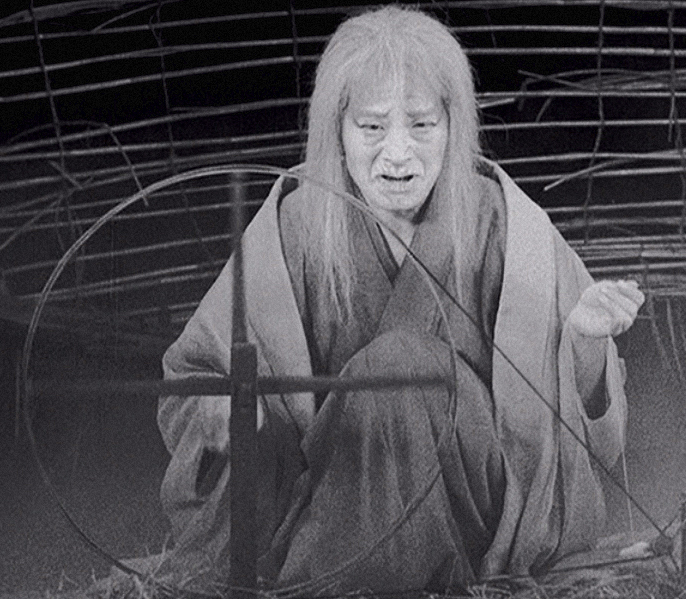
    Throne of Blood is a japanese  movie  by Akira Kurosawa,  where  they tell the story of  Washizu,  a man  that  won a   battle  in the middle of the war, and he wons also, the respect from  Tsuzuki, his lord. Just after this,  in his way home,  he   found  a   man that  started to  say everything that will happen   to him, just like a profecy, and when  he arrives home, his  wife told him that  he should   look forward  acomplish these profecies.

     I've  heard something like this before, in  another  place...  Well,  ladies and gentlemen,  this story is   Kurosawa's  version of Shakespeare's "Macbeth", where the  main  character  is part of the  army   and  he won   the most difficult  fight, and because of this,  he won the respect and  honor given by the  Lord,  but also he  won  the posibility  to  be the  next  in the throne. Just after these news were given to him,  he   walks  home and  in  his way home,   he finds somebody  that will tell him  his future. The news were heard  by his wife, who would  make him to  do bad things so  he  gets all the power. 

    In this case, the  most notorious  difference would  be  the place where the story is placed,  because in one it is  Scotland, and  the other one  is  in Japan;  and the  years in which they are placed, because Macbteh is placed  during 1500, and  Throne of Blood is placed   aproximately  in the 1180, while the Tempei wars were  taking place;another  main difference would  be  the  name of the characters, based  in   what does the  culture and  what does the story  say.  Also,  one  of the most notorious  characteristic so far would  be that  the witches  become only one, and  it is a man , the most creepiest man I've ever seen,  because I imagined  the witches as  very active people  making  bad thing  in the forest while they talk to  Macbeth, but in this case,  the  spirit just  stays  sitted doing some  thread and looking to  anywhere.

    Also, another notorious   thing   as a difference,  would be  the way Asaji-dono convince  Washizu, because in the book, Lady Macbeth is a strong woman  who  looks forward   the power, and  she   talks to her husband   in a strong and hard way,  showing that she "wears the pants" in the relationship", but   Asaji-dono is completelly  different, because, she is as sweet as a candy, because  even thought that  she  tries to be as bad a Lady Macbeth,  her culture puts the woman in  the lowest  level, and they cannot even  say anything, but she, with her sweet voice,  convinces  Washizu  to do whatever she wants.


     In this case, I think that  Kurosawa tried to empasize the  power of the man, and also, the power of  the words, because   in this case, with  fewer words,  they said what  Shakespeare  wrote, and wih the same  force  that the words have; also  he tried  to emphazise that they are different, but at some point, the mesaage and the main purpose of  it. In my opinion, I liked the way  we   notice the different perspectives  that  each of us gives to the same  play, and I think that  the result would be the same if each of us  played the  play   using the same   things, such as   the background and  other characters.

    martes, 28 de enero de 2014

    It's our nature


    All the world's a stage,
    And all the men and women merely players.
    They have their exits and their entrances,
    And one man in his time plays many parts...
    -William Shakespeare-

    As in any play, or book, the characters have  merly human characteristics, they speak, they think, they  act, they are just la you, just like  me. That is one reason   why we read books of any kind,  we feel  connected to the character, not just because we know him from the  begining, but because  he or she does  many things  we would like to do,  does things we do, act like we do (or like we should) and  just  because they are too human to  be in a book.
    In this case, as we were reading Macbeth,  maybe we did no feel  like a man who murdered  a king,  but we could feel  the guilt that  he had just after  he  did  it, he became mad, just because of it like  in Act 2 Scene 4 when Macbeth is at a party  just after he killed Banquo, he sees him   in his seat ; he   said : "Thou canst not say i did it, never shake Thy gory locks at me"  and everybody thought that he was  sick, but then ,lady Macbeth  takes him out from the livingroom and talk to him  about it, because  he was too obvious, and the scene continues. In this case,  we can relate  to the scenen when we  fail an exam or  we did something we are not proud of it, and just somebody knows. When we  feel that the feeling of guilt is killing us inside,  the guy or girl will help us to "keep in line" and to keep the secret.

    Another case could  be when Lady Macbeth  starts to walk at night and  she says  what she said to Macbeth just after he killed Banquo, because,  this is  a upset  where the guilt is "killing you from inside" and   your  inconciousness  acts  saying what you did not want to reveal, just to take out this feeling of  guilt. In  our case, sometimes it not as drastic as  in the play, but  we do things  inconciously, like movements, gestures, and sounds that we continue to say until  the truth comes out.

    On the other hand, when  you know the truth  of anything, sometimes you look for the right moment  to tell it, just like Macduff   used it  against Macbeth,   when he said "I have no words, my voice is in my sword; thou bloodier willian, That terms can give thee out" and their battle  began , where  he reveals other things, that  little by little kill Macbeth (metaphorically speaking), just to end in  a simple fight. Sometimes we, as humans use this,  to arrive at the right moment and time, to tell the exact words   to  hurt  somebody intentionally. For example, when we know  that  our girlfriend or boyfriend has cheated on us,  and  we wait  a bit to see if she or he  tell us the truth,  but as time goes by,   our anger grows up, and we cannot hold the feeling  anymore, so when we  decide to talk, you know  why are you there, and what  will you do to hurt the other person, just like he or she did to you, like a revenge.

    In this case, I think  that Shakespeare tried to  show the nature of power and its limitations as a human, because  at some point this is a great responsability that can make us  crazy enough for us to never  be satisfied with it. In this case, recognition brought this,  and  the characters became  the worst, like proud,arrogant and smart to get  it all,  but they did not became  intelligent,  the reason of this is that  if they have been intelligent enough,  they could controll  the situation  and avoid anything of this. Also,  the characters played  many roles at the same time,  because they could  be  the  sweetest person in the world  with somebody, but the worst with somebody else, and this  is a  mascarade  game, where nobody knows who you really are,  including ypourself,  so  you end up with  many things in mind except for  who you are.
    In conclusion,  Shakespeare used this play not only to show another perspective from a real fact, but to show what  humans could do just to get a little power, no matter who you are,  or how strong you are. Further more,  this   play , as one of the most played ones,  he wanted to show  a fight for power not between other humans,  but with yourself,  the fight where you discover your goals, and what  you really need to do to get   it ,  or the fight where you  discover yourself, as simple as this,  because as the play flew, the  characters  little by little didn't knew what to do with  the  power that they were reciving, so  it consumed them because the power was  bigger than the one  they were expecting and the way the got into it  was not the best.


    martes, 21 de enero de 2014

    New year, new books.

    “Life ... is a tale
    Told by an idiot, full of sound and fury,
    Signifying nothing.”
    -William Shakespeare- Macbeth-

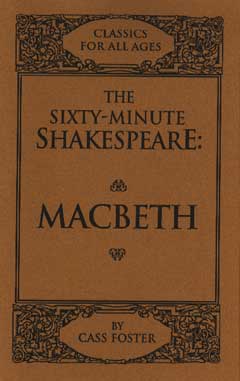
    This play, written by William Shakespeare, father  of English,  in 1606 (aprox.),  tells the story about a man  named Macbeth, controlled by  his wife: Lady Macbeth,  who murdered  the  king, just after  it is said  that  maybe Macbeth could   be the  next  king  of Cawdor; this is followed   by development of  guilty  in Macbeth  that ended  with other murders based in the  feeling of "Maybe  he saw me?".

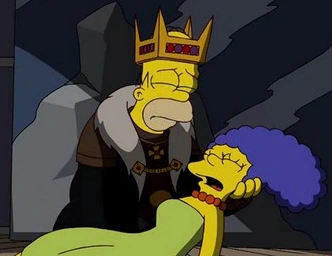
    In first place, to  understand  this play,  we  can read it  in English, the "modern"  version and erase all those  words that we do not know , so we can do this  report and  live  happily ever after... Not, if you wanted to do that,  you should  watch "The Simpsons" parody and   that's it. Because   this play  is one of the most  well-known   and  one of  the most played plays  around the world, and  we , as   people  who like to read,  can   grow  up our vocabulary, look for what the  author tried to say, and as  simply as we do, read it outloud in  class hear  the  rithm that it follows, that at the  same time   gives us the atmosphere   of the   scene; we can  understand the whole play, with this little  characteristic.
     Just after  your read the   scenes, acts, or any way  you read it, I recomend  you one thing, read it  outloud,  this way you can imagine  the way the  actors could  play this, and  even  understand   somethings that  you didn't, also, as this play  might be  in "old English"  dont worry if  you read it 10 times and untill the 11th  you understand it, because  this is no  easy exercise and  no matter how many times you do it,  the  thing is that you understand it. 
     When you finally understand it,  you can get into  many conclusions, and they  might vary as you read the   play and   look for  the context. For example, the theme in this story, in the first act,  shows a man who  is  strong, corageous, and  fair; in this part we can  think that the play would  be  about a  "Manly man"  that would  become the best king , but  in the second act,  we  meet Lady Macbeth, who is  a  woman that can  control  her husband  so that  she does whatever  she  wants, without getting her hands "dirty",  and we can think that the play  is about a "Manly man" that  is controlled  by his wife. Finally, almost at the end  we discover that  Macbeth is becoming mad, because he killed  the King,  so the  theme  would  be " Madness generated  by the guilt of  a Manly Man controlled by  his wife";  I know a bit  longer, but as I have not finished reading it,  I cannot  get to a real or possible theme, and also, as  the characters develop, I can create  other  themes; for example  "Lady Macbeth's  sides, and the consequences  of  what do they generate"
    To finish the  exercise of reading this  kind of books and stories,  you can reaaly think about what you like and dislike about  it. In my case,  I love theatre and  to read play,   but I do not like to read them in a group without really  playing  it, even thought that we do not know what it is about, I think that it  gives it dinamism, movement, and you can really follow the play. Also  I love the way in which Shakespeare  ends each act, with something that  mantains me there, waiting for more, and  the way he uses  metaphores to tell us the truth, to tell us  what is really happening  or what will happen  in the next  scene or act, but if we  do not analize it, we  stay   there, just to discover what we know.
     
    In conclusion, I love to read  this  author, he is one of my favourites, and this play is also in my "Top five" from him,  not only because he uses  the rithm  in a way in which  you understand him  without even know many of the words he uses , but  because  in this play he  wrote about  the woman  as someone  who is as strong as a man, but  because of the time  that it is placed,  she cannot be  someone well recognized, and no matter what, she   is  strong and   does  whatever she wants, because who will suspect from a  woman? As last point,  two curious facts  from this play,  when it is played , is that  involves the bad luck  in it; the origin of the belief that it’s unlucky to say “Macbeth” in a theatre is unclear. Some blame early disasters in performances, or "accidents" that  the actors suffer just  before the  play starts, and also  If you do say “Macbeth” in a theatre, you are meant to walk three times in a circle anti-clockwise, then say a rude word or spit. 
    Good luck
    Poison Rain