martes, 18 de febrero de 2014

Poetry, more than love.

Last week, we changed   the stories in prose,  to stories in verse; we changed the  defined characters, to   the undefined, we changed  the  narrator  talking to somebody ,  to a narrator talking to anybody. We  changed  the long stories, to short ones; We changed   the   dialogs,  to monologues,  we decided to  change   the  specific  themes  to  the non-specific and  hidden   themes. We did all these, because  we are goint to read   some poems,  the  author  in this case will be John Donne. 


Before we can read anything about poetry, we must know  what  it is, and according to Octavio Paz,   it  could be  anything,  from   just knowledge  to  something that can change  the world, also  it could be   your own life, someone elese's live, and so on , it could be  anything.  And according to me,  poetry is a way in which we can  change the way we express and  it  has no reason to be, it  just appears and  sometimes  it is good  or it   is bad, but  we   just  use it  to  "take  out" everything   from  inside us, and  just  leave it there, so that   anybody that reads  it  gives it a meaning. 
While  we were  discussing  about  what is  poetry for  us,   I got into my own  conclusion,  and  it    has not change a lot since we started, because  I thought that poetry is a way in which  we   can express anything with a certain format (verses)  and it uses retoric and   the other   figure of speech,  which  we know  but we do not know what it's name,  but what I've leared is that   it  can really   mean something to   anybody that reads it, and there are no special meanings  for the  position  of the words, sometimes it just   happens  like that and  the author  is ok with it because it means what  he or she wanted. 

In conclusion, poetry can be anything,  and the author decides   the words,  but the reader decides the meaning  of it, and what it will mean in his life.  Also  even thought that we  say that  something is red,  somebody else  can see it  blue,  and  everyting  in poetry will be  managed  by  the reader and   what  he knows and thinks.
 

martes, 11 de febrero de 2014

About to finish...

Semiotics  is  a  defined as  the  study of the signs, any sign that exists  including words, images, body languages and  sounds. this  part of the  linguistic  does not come alone,  it comes with semantics ( what does the  sign stands for), syntax (the relation between the signs) and pragmatic (the relation with the interpreters).

In this case, what i've learned  is that  many things in a play,  book, advertisements and even us, mean many things. In this case,  it  makes  me  feel interested in this  details that normally I ignore,  but, as time goes by,  I think that  I would pay more atention to these details, becase as you analize them,  you discover  many things that  are obvious the other person, sign, words, etc that  really can make a change in your life, and  as you learn them,  you can use them  for your  own benefit, in any case you need. For example,  when you  need to talk in public you must look relaxed and   your voice needs to be  toned depending  to who you are talking  to, or when  you are doing an announcement, you could use certain colours  to make it  more attractive according to your  product.

Another example, could be   to analize one if the scenes  of the book we  read, so we understand  everything that happened. Talking about   the  book we read, I can tell you that even thought I made this step many times and with different scenes,  the  first  thought or idea that  I had just after I finished the book: "power is  bad", well not as simple as that, but this is the main idea,  because  this play talks about  power and what does a  man and a woman do   to get it,  and  the methods that they used, were not good for what they did,  in the context of  the psichological way,  the reason,  they  got mad   through all the play   because the guilt was killing them from inside. Shakespeare developed  this by the  use of the psichological game  made by Lady Macbeth to her  husband, and his reaction  slowly killed  him,  and got  him  death.

 In conclusion,  this topic  is important because we   really understand  why many things happen that way, and we, as humans, act almost the same way, so we can  relate this and  avoid any of the actions we do. 
 

martes, 4 de febrero de 2014

マクベス (Macbeth)

Throne of Blood is a japanese  movie  by Akira Kurosawa,  where  they tell the story of  Washizu,  a man  that  won a   battle  in the middle of the war, and he wons also, the respect from  Tsuzuki, his lord. Just after this,  in his way home,  he   found  a   man that  started to  say everything that will happen   to him, just like a profecy, and when  he arrives home, his  wife told him that  he should   look forward  acomplish these profecies.

 I've  heard something like this before, in  another  place...  Well,  ladies and gentlemen,  this story is   Kurosawa's  version of Shakespeare's "Macbeth", where the  main  character  is part of the  army   and  he won   the most difficult  fight, and because of this,  he won the respect and  honor given by the  Lord,  but also he  won  the posibility  to  be the  next  in the throne. Just after these news were given to him,  he   walks  home and  in  his way home,   he finds somebody  that will tell him  his future. The news were heard  by his wife, who would  make him to  do bad things so  he  gets all the power. 

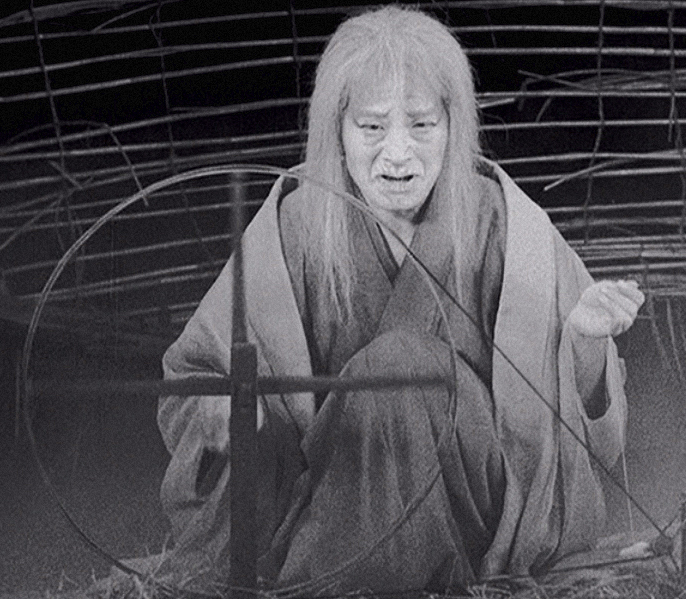
In this case, the  most notorious  difference would  be  the place where the story is placed,  because in one it is  Scotland, and  the other one  is  in Japan;  and the  years in which they are placed, because Macbteh is placed  during 1500, and  Throne of Blood is placed   aproximately  in the 1180, while the Tempei wars were  taking place;another  main difference would  be  the  name of the characters, based  in   what does the  culture and  what does the story  say.  Also,  one  of the most notorious  characteristic so far would  be that  the witches  become only one, and  it is a man , the most creepiest man I've ever seen,  because I imagined  the witches as  very active people  making  bad thing  in the forest while they talk to  Macbeth, but in this case,  the  spirit just  stays  sitted doing some  thread and looking to  anywhere.

Also, another notorious   thing   as a difference,  would be  the way Asaji-dono convince  Washizu, because in the book, Lady Macbeth is a strong woman  who  looks forward   the power, and  she   talks to her husband   in a strong and hard way,  showing that she "wears the pants" in the relationship", but   Asaji-dono is completelly  different, because, she is as sweet as a candy, because  even thought that  she  tries to be as bad a Lady Macbeth,  her culture puts the woman in  the lowest  level, and they cannot even  say anything, but she, with her sweet voice,  convinces  Washizu  to do whatever she wants.


 In this case, I think that  Kurosawa tried to empasize the  power of the man, and also, the power of  the words, because   in this case, with  fewer words,  they said what  Shakespeare  wrote, and wih the same  force  that the words have; also  he tried  to emphazise that they are different, but at some point, the mesaage and the main purpose of  it. In my opinion, I liked the way  we   notice the different perspectives  that  each of us gives to the same  play, and I think that  the result would be the same if each of us  played the  play   using the same   things, such as   the background and  other characters.